How to Choose the Best CBD Product for Your Lifestyle?
Quick Summary It’s Not About the Strongest Product; It’s About the Right Fit The CBD market has grown rapidly over the past several years, giving

• A 2025 survey of 400 C-suite executives found more than half were very stressed, with levels surpassing even pandemic highs.
• Researchers identified six distinct leadership stress response types, each shaped by how a leader appraises stress and how composed or action-oriented they tend to be.
• Every type has real strengths worth building on, as well as blind spots that can quietly undermine teams if left unchecked.
• Recognizing your default response is the first step toward expanding your range under pressure.
• No single type is universally effective, and the most resilient leaders learn to shift their approach as situations change.
• Building a balanced leadership team and a trusted support network are both practical ways to manage stress without carrying it alone.
Leadership stress is not a new problem, but the scale of it right now is hard to ignore. A September 2025 survey conducted by Brunswick Group tracked 400 C-suite leaders across large corporations in the United States, United Kingdom, Germany, and Japan. More than half said they were very stressed, nearly two-thirds reported their stress had increased over the past year, and the majority expected it to keep rising.
What makes this moment unusual is that stress levels among senior leaders are now higher than they were at the peak of the pandemic. That context matters. It means leaders are not just managing difficult moments. They are operating inside a sustained, elevated state of pressure with little sign of relief ahead.
Jon Miller and Drew Keller, co-founders of the Center for Stress Intelligence, developed a framework to help leaders understand not just how much stress they carry but also how they instinctively respond to it. Their model draws on foundational work in psychology, including research by Richard Lazarus and Susan Folkman on whether people appraise stress as a threat or an opportunity and James Gross’s work on how people regulate emotions. What emerged is a set of six recognizable leader types.
At Calm by Wellness, we believe that understanding your stress response is one of the most practical things a leader can do. When you know how you naturally react under pressure, you can begin making more intentional choices, both for yourself and for the people you lead. Explore our guide to daily stress management for simple practices that support clarity under pressure.
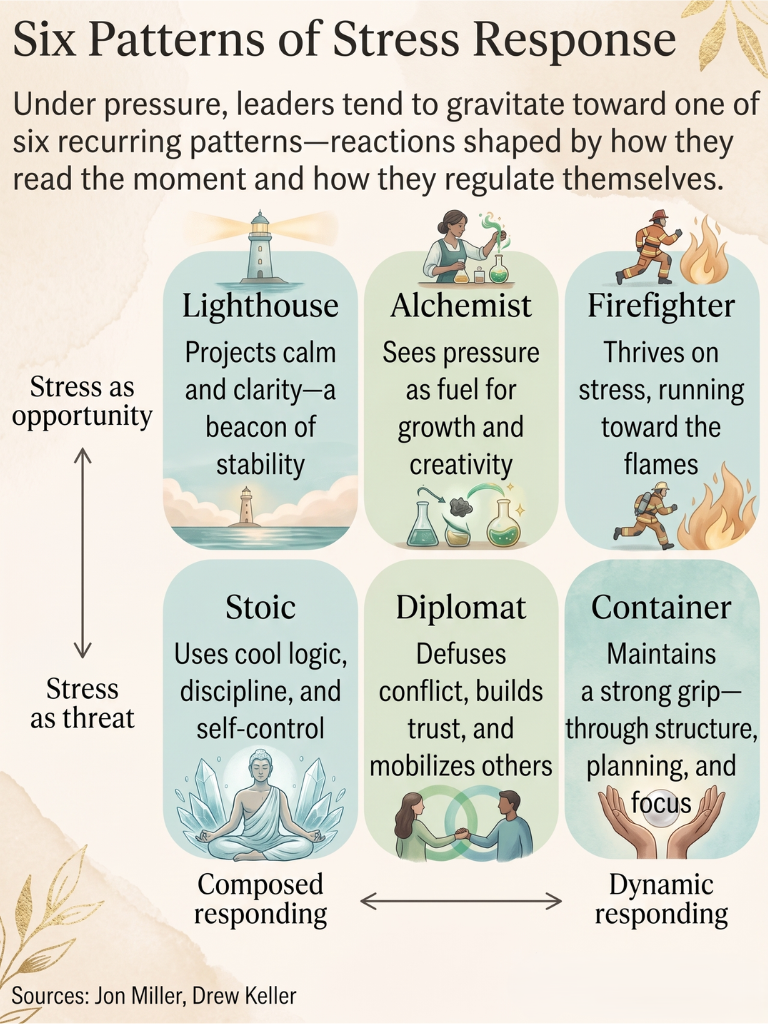
Each type sits somewhere along two spectrums. The first runs from composure to dynamic action. The second reflects whether a leader tends to see stress as an opportunity to seize or a threat to contain. Where a leader lands on both spectrums shapes everything from how they communicate in a crisis to where their judgment breaks down.
The Lighthouse stays calm and reads stress as an opening rather than as a danger. This leader holds the team steady, maintains psychological safety, and keeps people focused when everything feels uncertain. Research on high-reliability organizations, including air traffic control teams and hospital emergency units, points to this kind of steadiness as a real asset when panic could otherwise spread through a group.
The risk is that calm can read as detachment. Silence gets misread as indecision, and over time, stability can harden into inertia. This leader may also absorb too much pressure privately. A practical adjustment is to name the intention out loud, something like explaining that staying calm is a choice made so the team can think clearly, not a sign of disengagement.
The Alchemist combines composure with a drive to act and sees disruption as raw material for something better. This type tends to thrive in environments defined by rapid change, such as artificial intelligence or climate technology, where the ability to connect unexpected dots is a competitive advantage. The orientation here is captured well in a quote attributed to Reed Hastings: Be honest about short-term difficulty while staying genuinely optimistic about where things are heading.
Under sustained pressure, the Alchemist can slide from visionary to chaotic, and teams may feel exhausted by constant pivots. Anchoring the transformation to a clear purpose and building in deliberate pauses between pushes for change helps keep momentum without burning people out.
The Firefighter is energized by urgency, moves fast, and brings others along through decisive action. This type draws on what researchers call action bias, the idea that taking any action under uncertainty reassures both the leader and the team that progress is being made. West Point’s research on in extremis leadership describes similar qualities in those who perform well in genuinely dangerous, high-stakes situations.
The challenge is that over time, every problem starts to look like an emergency. Decisions become impulsive, teams burn out, and the leader may unconsciously escalate situations rather than contain them. One former COO put it this way: the feeling of fighting fires can be deeply satisfying, but you have to watch carefully that you are not the one fanning the flames. Pausing before acting and bringing others in early to share the cognitive load are both protective habits for this type.
The Stoic leads with reason and principle, stays composed under pressure, and manages internal volatility without letting it surface. This approach supports clearer analysis when situations are genuinely ambiguous. This mindset has been described as focusing only on what you can actually control.
The blind spot here is that emotional steadiness can tip into emotional absence. Teams may feel unseen during difficult moments, and the Stoic may experience insomnia, fatigue, or quiet burnout from suppressing rather than processing stress. The shift is subtle but important: regulating emotions is healthy, but suppressing them entirely carries a cost. Making space to acknowledge stress with a trusted coach or peer helps this type stay grounded without bottling everything up.
The Diplomat leads with relationships during hard moments, using dialogue and tact to ease tension and maintain trust across the team. This is what researchers describe as relational regulation, using connection with others to manage stress rather than facing it alone.
The Diplomat’s composure can become caution, and the instinct to preserve relationships can quietly crowd out honest conversations. One executive described preferring a slightly imperfect decision that everyone supports over the right decision that divides the team. That instinct has value, but pushed too far, it delays necessary clarity. Building structured ways to surface disagreement, such as premortems or red-team exercises, helps this type make space for honest input without it feeling like conflict.
The Container imposes structure when systems are under strain, holds competing demands together, and keeps panic from spreading by maintaining clear decision rights. Intel’s former CEO Andrew Grove, known for the phrase only the paranoid survive, embodied aspects of this orientation. This type often leans on a tight inner circle to move quickly and coherently.
The risk is that people outside that inner circle feel excluded and disconnected, which erodes the broader team’s ability to contribute when it matters most. The Container also tends to absorb pressure quietly rather than releasing it. Deliberately building in time for reflection and recovery, and modeling rest as part of sustained performance rather than a sign of weakness, are both important adaptive moves for this type.
One of the more useful ideas in this framework is what the authors call the fallacy of uniform efficacy. This is the belief that because a particular approach worked once, it will work every time. It is one of the more common traps in managing stress as a leader over a long career, and it explains why even highly experienced executives sometimes make puzzling decisions under new kinds of pressure.
Crises rarely arrive with clear labels. An activist investor, a cybersecurity breach, and a geopolitical rupture each create very different demands, and a style that is perfectly calibrated for one situation may be exactly wrong for another. Default responses shape what a leader notices, how quickly they move, and where their judgment has gaps. Understanding your type does not mean changing who you are. It means knowing when your natural instincts are serving the situation and when they need adjusting.
The practical goal is not to become a different kind of leader but to expand the range of responses available to you. That means testing and adjusting in real time rather than assuming one playbook will cover every scenario. It also means distributing the cognitive load, because no single leader can hold all of it alone without eventually paying a price.
One concrete step is designing your leadership team with complementary response types in mind, so that gaps in one style are naturally covered by someone else’s strengths. Another is building a reliable group of peers, mentors, coaches, or therapists before a crisis hits, not after. And for those who want to identify their type directly, the Center for Stress Intelligence offers a self-assessment at stressintelligence.org/test.
Leadership stress is not going away, and the data suggest it is getting more intense. What can change is how prepared leaders are to work with their own stress responses rather than being driven by them. Knowing which of these six types you default to is a practical starting point, not a label, but a map that helps you navigate more deliberately.
The leaders who handle pressure best over time are not the ones who feel no stress. They are the ones who understand their patterns well enough to choose something different when the situation calls for it. That kind of flexibility is a skill, and like any skill, it develops with practice, reflection, and the support of people who will tell you the truth.