7 Everyday Meals That Boost Your CBD Bioavailability
Quick Summary If you take CBD edibles, it helps to know that not every dose is absorbed the same way. The reason comes down to
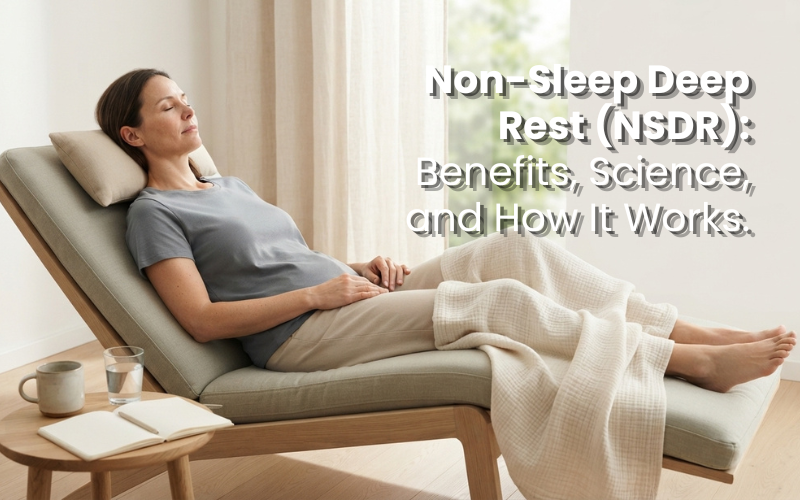
Non-sleep deep rest, or NSDR, is a term coined by neuroscientist Andrew Huberman. It describes guided relaxation practices that bring the brain into a deeply restful state while a person remains conscious throughout. In many ways, it is a modern, secular framing of older practices like yoga nidra and meditation.
NSDR typically involves:
Huberman removed the spiritual language from these older traditions while keeping the underlying mechanism intact. That mechanism includes a body scan, intentional breathing, and a shift in the nervous system from an activated state to a calm one. It has been described as landing in a deliberate middle ground between being fully awake and fully asleep.
The defining difference between non-sleep deep rest and standard meditation, according to this expert, is passivity. Most meditation practices ask a person to stay mentally engaged and focused. NSDR instead asks the person to simply follow the guidance, let go of effort, and remain passive for the length of the session.
This shift also shows up in the brain’s electrical activity. When the brain is active and focused, it operates in the beta range. When it relaxes, it shifts into alpha. NSDR is described as guiding a person into alpha and theta activity, which are the same slower brainwave patterns present during the lightest stages of sleep.
Non-sleep deep rest can genuinely help a person feel more rested, but only to a point. People practicing NSDR enter a physiologically distinct state marked by reduced arousal, slower breathing, decreased sympathetic nervous system activity, and an increased sense of restoration.
What remains less settled, she said, is whether non-sleep deep rest should be treated as its own distinct scientific phenomenon, separate from established practices like yoga nidra and meditation, or whether it is largely the same mechanism under a new name.
Many people do report feeling calmer, more mentally refreshed, and more focused after a 10 to 30 minute NSDR session. Emerging research suggests these practices may help reduce stress and improve mood, support subjective recovery, and potentially benefit cognitive performance, though this area of study is still developing.
The research picture on non-sleep deep rest is mixed, and it helps to separate what has been studied directly from what has only been studied in related practices like yoga nidra.
A 2024 study of 65 physically active adults found that a single NSDR session led to meaningful improvements in physical readiness, emotional balance, recovery, and perceived stress compared with a control group.
Much of the stronger evidence, however, comes from yoga nidra rather than NSDR specifically. Multiple studies on yoga nidra point to reductions in cortisol, lower heart rate, and reduced activity in the brain’s threat response system. A 2026 systematic review of randomized controlled trials on yoga nidra found improvements in sleep onset time, total sleep time, and sleep efficiency among people with sleep-related difficulties.
Findings on cognitive performance are less consistent. The same 2024 study on physically active adults found improved reaction time and accuracy after a single 10 minute session. By contrast, a 2024 study out of Harvard tested an NSDR protocol on sleep-deprived university students and found no significant effect on attention or working memory.
A widely repeated online claim states that NSDR can increase dopamine by 65 percent. That figure traces back to a small 2002 PET imaging study involving only eight participants, and it has not been widely replicated since. The underlying idea is considered plausible, but the specific percentage should not be treated as settled science. Some of what circulates online outpaces what the current evidence actually supports, even though a session of guided body scan relaxation (Internal link: simple mindfulness exercises to try) will still produce a measurable shift in brain state.
While non-sleep deep rest can guide the brain into a relaxed state, it is not the same as sleep. Deep relaxation can help a person feel partially restored, but it cannot replace the biological functions that sleep performs.
During actual sleep, the brain moves through distinct stages, including deep sleep and REM sleep, that are essential for memory consolidation, emotional processing, metabolic regulation, and the brain’s natural clearance processes. There is currently no evidence that non-sleep deep rest can fully reproduce these functions.
From a practical perspective, NSDR can be a useful tool for stress management, recovery, and daytime restoration, particularly for people who struggle to nap. At the same time, the scientific evidence remains considerably stronger for yoga nidra and meditation than for NSDR as a separate category, and any claims suggesting it can replace sleep should be viewed with skepticism.
Given what the research does and does not support, non-sleep deep rest is best treated as one part of a broader approach to rest and stress management rather than a stand-in for sleep itself. A short guided session during a stressful afternoon or before a demanding task can offer a real, measurable shift toward calm, even if it will not replicate what a full night of sleep provides.
Some people find it helpful to pair a short NSDR session with a simple calming ritual beforehand, such as a few minutes of quiet breathing or a warm, comforting drink. CBD products are sometimes used in this kind of pre-rest routine, since a small, consistent cue can make it easier to settle into a passive, relaxed state before the session begins. The goal is not to complicate the practice, but to build a simple pattern the body can learn to recognize.
Because the evidence base for NSDR is still developing, it makes sense to treat it as a helpful daytime tool rather than a solution for chronic sleep problems. Anyone dealing with ongoing sleep difficulties should still prioritize consistent sleep habits and speak with a healthcare provider if problems persist.
Non-sleep deep rest offers a genuinely useful way to shift the nervous system toward calm, and the small amount of direct research on NSDR, along with the larger body of evidence on related practices like yoga nidra, supports real benefits for stress, mood, and recovery. At the same time, experts are consistent on one point: non-sleep deep rest is not a substitute for sleep. It cannot reproduce the specialized brain activity that occurs during deep sleep and REM sleep, and claims suggesting otherwise outpace what the current evidence shows. Used as a daytime tool rather than a sleep replacement, non-sleep deep rest can still be a simple, low-cost way to support a calmer, more resilient day.
Non-sleep deep rest is a guided relaxation practice that brings the brain into a deeply restful state while a person stays conscious. Coined by neuroscientist Andrew Huberman, it draws on techniques found in yoga nidra and meditation.
Most NSDR sessions run between 10 and 30 minutes. Research on related practices suggests even a single 10-minute session can produce a measurable shift in brain state, though longer sessions are more commonly studied.
No. A nap involves actually falling asleep, while NSDR keeps a person awake and aware throughout the session. This is one reason experts see it as a useful option for people who cannot nap easily.
No. It can help a person feel more rested, but it cannot reproduce the biological functions of actual sleep, including memory consolidation and brain clearance processes that occur during deep sleep and REM sleep.
That specific figure comes from a small 2002 study with only eight participants and has not been widely replicated since. The general idea is considered plausible, but the exact percentage should not be treated as settled science.
Quick Summary If you take CBD edibles, it helps to know that not every dose is absorbed the same way. The reason comes down to
Quick Summary Interest in CBD for seniors has grown as more older adults look for gentler options for everyday concerns. Experts say that cannabis can
Quick Summary You open a drawer and find a bag of gummies with a date that passed months ago. If those gummies contain CBD or
Quick Summary New federal hemp rules are scheduled to take effect on December 11, 2026. Under those rules, hemp products that contain measurable amounts of
Quick Summary Imagine you recommend your favorite CBD product to a friend, and their experience turns out to be nothing like yours. Maybe 10 mg