
CBD for Seniors and How to Use It Safely
Quick Summary Interest in CBD for seniors has grown as more older adults look for gentler options for everyday concerns. Experts say that cannabis can
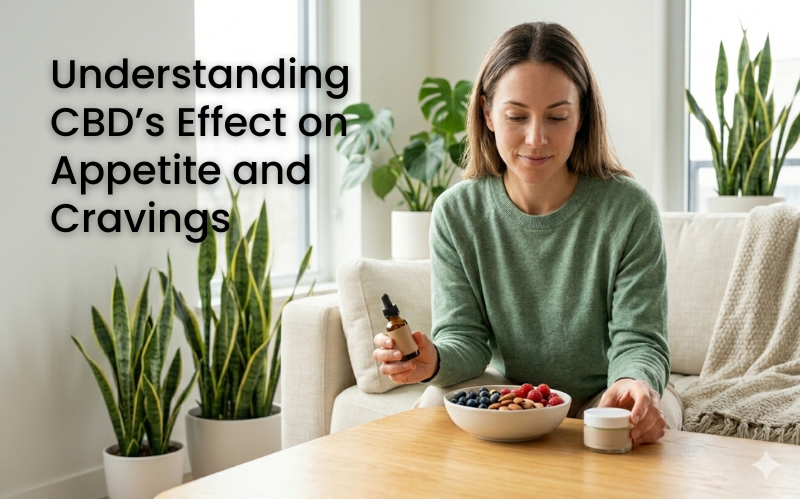
If you have ever wondered, “does CBD make you hungry,” the answer starts with understanding how your body processes cannabinoids in the first place. Your body has a built-in network called the endocannabinoid system, or ECS, which regulates sleep, pain response, mood, and appetite through two main receptors: CB1 and CB2.
CB1 receptors are concentrated in the brain and central nervous system. When something binds to them strongly, the brain receives a clear signal to eat. THC works this way. It locks directly onto CB1 receptors, triggering the hunger response that most people know as “the munchies.”
CBD does not do this. It has very little direct interaction with CB1 receptors and works through indirect pathways instead. Rather than taking over appetite signaling, CBD modulates how the ECS responds to various conditions in the body. Understanding this distinction is what makes the question “does CBD make you hungry?” so easy to misread.
The short answer is: not directly.
Because CBD does not activate CB1 receptors, it does not produce the craving-driven hunger that THC is known for. However, CBD can change the conditions around appetite in ways that feel similar. What was happening in your body before you took it tends to matter more than the CBD itself.
Persistent stress is one of the most common reasons people lose interest in food. When the nervous system stays in an elevated state, hunger cues can fade or disappear entirely. Eating starts to feel like an obligation rather than something the body is asking for.
CBD interacts with serotonin receptors, specifically 5-HT1A, in ways that may help support a calmer nervous system state. When that underlying tension eases, appetite that was being suppressed tends to return on its own. The hunger was already there. CBD cleared what was sitting on top of it. (Internal link: [how CBD supports stress relief])
Nausea is another barrier that keeps people from eating. Research has supported CBD’s antiemetic properties, meaning its ability to help reduce the urge to vomit or that persistent low-level queasiness that makes food unappealing. When nausea clears, the desire to eat often follows naturally.
This is part of why CBD has been studied in the context of chemotherapy-related side effects. The goal is not to manufacture hunger from scratch but to remove what was blocking it. That distinction is important.
Sleep deprivation quietly disrupts appetite in ways that go unnoticed until someone finally starts sleeping better. Two hormones, ghrelin and leptin, govern hunger and fullness signals. Ghrelin rises when the body wants food. Leptin signals that you have had enough. Both depend on consistent, quality sleep to stay calibrated.
When sleep is poor or irregular, ghrelin can climb while leptin drops. The body genuinely loses its ability to read its own hunger accurately. People who start sleeping better often notice they feel genuinely hungry in the mornings for the first time in months, and some attribute that to CBD directly.
What actually happened is that better sleep recalibrated those hormones. CBD may have helped by addressing whatever was disrupting sleep, whether that was physical discomfort, mental restlessness, or both.
The variability people notice when asking “does CBD make you hungry” often comes down to the product, not the person.
Full-spectrum CBD contains the full range of compounds naturally present in hemp, including trace amounts of THC. Even a small amount of THC can nudge CB1 activity and produce a mild appetite bump. In contrast, CBD isolate and broad-spectrum products contain no THC and are far less likely to shift hunger in any direction.
CBG, another minor cannabinoid present in some full-spectrum products, has shown appetite-stimulating properties in animal research. The munchies some people report after using full-spectrum formulas may trace back to CBG or trace THC rather than CBD itself.
Dosage adds a layer of complexity, though not always in the way people expect. A moderate CBD-only serving without any THC is unlikely to affect appetite meaningfully. A higher dose that includes THC or CBG changes the picture considerably. Spectrum type is usually the deciding variable, not the milligram count alone.
If you have been wondering why CBD from one brand or formula shifted your appetite while another did nothing, checking the spectrum type on the label is the most useful first step.
The published research on CBD and appetite points consistently in one direction: CBD on its own does not drive hunger.
A published study found that CBD actually reduced food intake in rats, producing a statistically significant decrease rather than an increase. That is the opposite direction from THC.
Human research supports the same pattern. A clinical trial tracking participants using CBD over several weeks found no meaningful changes in appetite, caloric intake, or body weight compared to baseline.
CBG research is more nuanced. A 2016 animal study observed a significant increase in food consumption with CBG, pointing to genuine appetite-stimulating activity through mechanisms different from CBD. Since full-spectrum products typically contain both compounds, appetite responses tied to those formulas may have more to do with CBG than CBD.
At a research level, the answer to “does CBD make you hungry” remains: not by itself, not in any meaningful or direct way.
Most people approaching this topic fall into one of two groups. Either they want gentle appetite support because stress, discomfort, or poor sleep has been affecting their ability to eat well, or they want their hunger left completely alone.
For those interested in appetite support, full-spectrum products that pair CBD with THC are worth considering. The combination activates CB1 receptors mildly while CBD provides a moderating influence. The result is a gentle nudge toward hunger rather than the intense craving response associated with higher THC amounts.
For those who want no appetite changes, isolate and broad-spectrum products are the better fit. No THC means no CB1 activation. No CBG means one less cannabinoid that could shift hunger. The calming and sleep-related benefits of CBD remain available without any effect on appetite.
If you are working toward more consistent eating patterns and better overall wellness, Calm by Wellness carries formulas across both ends of this spectrum, so you can choose based on exactly what your body needs.
Does CBD make you hungry enough to gain weight? Almost certainly not on its own. Appetite effects from CBD are indirect and mild. What CBD tends to do is normalize eating patterns rather than push them in either direction.
On the flip side, CBD is not a weight loss tool despite some early animal research showing that it may encourage white fat to convert into metabolically active brown fat. That research is interesting but has not been replicated in human trials and does not support any reliable claims.
What CBD supports most clearly are the habits and conditions that affect weight indirectly. Sleep quality, stress management, and physical recovery all influence how the body regulates appetite and metabolism. When those things fall apart, eating patterns tend to follow. CBD may help address those underlying factors rather than weight itself.
So does CBD make you hungry? Not the way THC does. CBD does not bind to the receptors responsible for triggering craving-driven hunger. What it may do is address the things that were suppressing appetite in the first place, whether that is stress, nausea, or disrupted sleep.
When people experience increased hunger after taking CBD, the cause is almost always indirect. Better sleep recalibrates hunger hormones. Calmer stress levels allow natural appetite to surface. Reduced nausea makes eating possible again. Or, the full-spectrum product they were using contained trace THC or CBG, which deserves most of the credit.
For appetite support, full-spectrum formulas that include THC are the most targeted option. For those who want hunger left alone, isolate or broad-spectrum products keep everything steady. The spectrum type is what matters most here, not the CBD milligram count.
Quick Summary Interest in CBD for seniors has grown as more older adults look for gentler options for everyday concerns. Experts say that cannabis can
Quick Summary You open a drawer and find a bag of gummies with a date that passed months ago. If those gummies contain CBD or
Quick Summary New federal hemp rules are scheduled to take effect on December 11, 2026. Under those rules, hemp products that contain measurable amounts of
Quick Summary Imagine you recommend your favorite CBD product to a friend, and their experience turns out to be nothing like yours. Maybe 10 mg
Quick Summary Broad spectrum CBD is one of three main types of hemp extract, alongside full spectrum CBD and CBD isolate. With so many labels