How to Choose the Best CBD Product for Your Lifestyle?
Quick Summary It’s Not About the Strongest Product; It’s About the Right Fit The CBD market has grown rapidly over the past several years, giving


Stress can feel deeply personal, but the new most stressed states in 2026 ranking shows that where you live can shape that experience in a real way. The report looked at 40 indicators across work, money, family, and health and safety. Instead of asking people one broad question about how stressed they feel, it measured the pressures that can build stress into daily life.
That broader approach helps explain why certain states landed near the top. In many cases, the highest-ranked states were not dealing with one problem. They were dealing with several issues at once, from poverty and long work hours to crime, poor health, weak job security, and housing strain.
The ranking grouped stress into four buckets:
Stress usually does not come from one source alone. It tends to build from overlapping pressures.
This also helps explain why the list includes very different states. One state may rank high because of long work hours and poor job security. Another may rank high because of crime, divorce, poor health, or housing costs. The path looks different, but the result can still be the same. Residents face more daily strain.
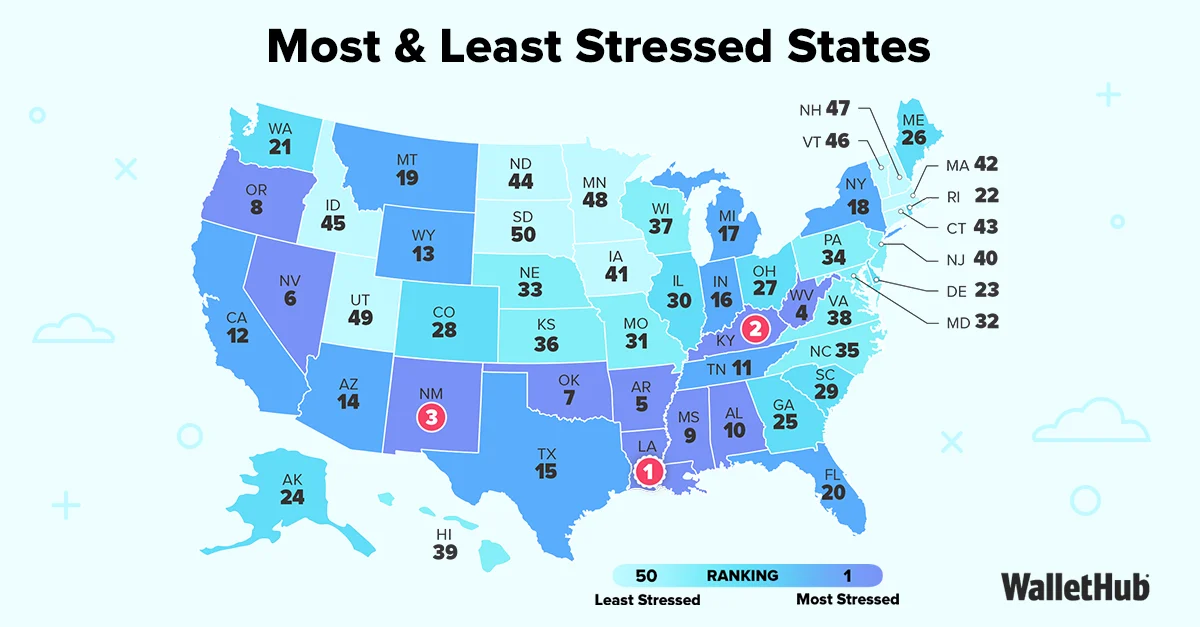
Louisiana stood out because stress was high in every major area. Work stress was especially severe, helped by the lowest job security in the country and some of the longest workweeks. Money stress was also high, with one of the highest poverty rates. Family stress was elevated too, and the state also ranked near the top for health and safety stress, with residents getting very little sleep on average.
Kentucky landed near the top because it ranked high across all four categories. It showed heavy pressure from work, money, family life, and health and safety. The study also pointed to a high poverty rate and a large share of adults who said their health was fair or poor.
New Mexico stood out most for family stress. It had the highest family-related stress in the country and the highest divorce rate. Money stress was also high, and health and safety concerns added to the overall burden, with the highest crime rate per capita.
West Virginia showed high stress in money, health, and safety. One of the clearest warning signs was health, as it had the highest share of adults who described their health as fair or poor.
Arkansas stood out because health and safety stress was the highest in the country. Money stress was also extremely high, which helped push the state close to the top of the overall list.
Nevada showed strong stress in money, family life, and health and safety. The report also noted that it had one of the highest divorce rates and some of the least affordable housing, which added to the pressure.
Oklahoma landed high because both money stress and family stress were elevated, and health and safety stress was also among the highest. The overall picture showed pressure across several parts of life at once.
Oregon stood out mostly for family stress. That category ranked especially high, while money and health-related stress also remained notable.
Mississippi was driven largely by money stress. It had the highest money-related stress in the country, along with some of the longest workweeks and the lowest credit scores.
Alabama’s stress profile was shaped mostly by money pressure and health-related strain. The report also noted that it tied for the highest poverty rate and the lowest median credit score.
Tennessee stood out because health and safety stress was especially high. The report also pointed to a very high crime rate per capita, which helped explain why the state ranked so high overall.
California’s stress profile leaned more toward family pressure and work stress. The report also said California had the least affordable housing in the country, which likely added to the strain.
Wyoming stood out for work stress. The report pointed to very low job security and long work hours as major reasons stress ran high there.
Arizona showed more stress in money and family life than in work. Family-related stress stood out the most, with health and safety also contributing.
Texas stood out in part because people worked some of the longest hours in the country. Health and safety stress was also high, helping keep the state on the list.
Indiana did not have one single standout factor. Instead, it showed moderate to elevated stress across work, money, family life, and health and safety.
Michigan also showed a more balanced stress profile. It was not driven by one extreme category, but stress remained fairly elevated across several areas.
New York stood out for family stress. It also ranked high in work stress, and the report noted that housing was among the least affordable in the country.
Montana’s main pressure point was money stress. The other categories were less intense, but financial strain was strong enough to keep the state in the top 20.
Florida’s place on the list was shaped mostly by family stress. The report also noted that it had one of the highest divorce rates in the country.
The strongest pattern in the ranking is cumulative pressure. The states near the top often struggled with several things at once, such as poverty, weak health, long hours, crime, divorce, and housing pressure. That kind of overlap matters because stress tends to intensify when problems pile up.
There is also a regional pattern. Many of the highest-ranked states were in the South. That does not mean stress is limited to one region, but it does suggest that broader economic and health conditions may be shaping daily life unevenly across the country.
This ranking is useful, but it does not tell the full story of what stress feels like for every resident. It measures conditions linked to stress, not private emotional experience. Some people in high-ranked states may have strong support systems and feel relatively stable. Others in lower-ranked states may still feel overwhelmed.
It is also shaped by methodology. Rankings depend on which indicators are chosen and how they are weighted. Even so, this one is still useful because it looks at stress from several angles instead of reducing it to a single mood question.
A ranking like this can explain patterns, but it does not remove the personal side of stress. When life feels heavy, the most helpful first step is often getting specific. Stress tied to money, work, health, or family may need different kinds of support.
Small habits still matter. Regular sleep, daily movement, balanced meals, and time away from constant notifications can help lower the background noise. Support matters too. A conversation with a trusted person, a therapist, or a healthcare professional can make stress feel more manageable when it starts affecting sleep, focus, or mood.
Stress can also spill into sleep, which often makes everything feel harder the next day. For people who already like building simple wellness habits into their evenings, a calming routine that includes less screen time, a consistent bedtime, and something like a CBD product may fit naturally as one small part of winding down, without needing to be the focus of the routine.
The most stressed states in 2026 ranking is not just a list. It is a reminder that stress is often shaped by everyday conditions. Louisiana, Kentucky, and New Mexico reached the top for different reasons, but all three showed how multiple pressures can pile up at once.
That is what makes the ranking feel useful. It gives a clearer picture of where stress may be hardest to escape, and why.