
Hemp THC Ban Is Coming, and Here Is What You Can Take Instead
Quick Summary New federal hemp rules are scheduled to take effect on December 11, 2026. Under those rules, hemp products that contain measurable amounts of
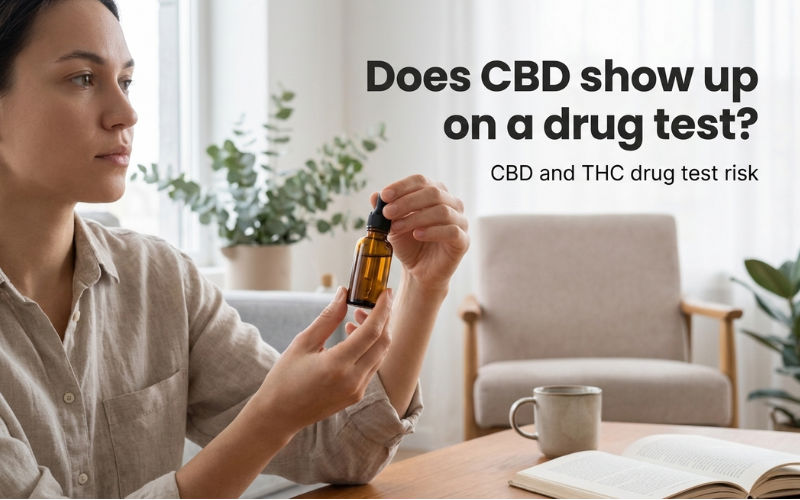
CBD is everywhere: in gummies, tinctures, creams, and even sparkling drinks. It’s legal in many places, doesn’t get you high, and is often marketed as “THC-free.” Because of this, a CBD drug test risk is a growing concern for anyone using CBD while subject to workplace or legal drug screening.
And here’s the problem: even one dose of the wrong product can make you fail a drug test.
If your job or legal status depends on staying clean, the CBD drug test risk isn’t just about long-term use. It can come from a single serving, especially if the product is mislabeled or contains more THC than advertised.
This guide breaks down how it happens, what to look out for, and how to protect yourself if testing is part of your life.
CBD stands for cannabidiol. It’s a non-psychoactive compound found in hemp. It doesn’t get you high.
People use CBD to feel calm, improve sleep, and manage physical discomfort. You’ll find it in oils, gummies, capsules, drinks, and creams.
The FDA has only approved one CBD-based drug for epilepsy, but many use it for wellness. Studies are ongoing. Results vary, and benefits aren’t guaranteed.
Drug tests look for specific chemicals, known as metabolites. These are what your body creates after processing drugs.
Most tests target THC, the main psychoactive compound in cannabis. CBD isn’t usually included.
Common tests include:
In most urine tests, a positive result occurs if the level of THC-COOH, a THC byproduct, exceeds 50 ng/mL.
This is the core issue. The CBD drug test risk comes from THC contamination.
Pure CBD won’t trigger a test. But many products contain small amounts of THC. Even trace levels can build up in your body. Over time, that may push your test result over the threshold.
In 2022, a study from Johns Hopkins found that over 20% of CBD products contained more THC than labeled.
CBD comes from hemp. By law, hemp must have less than 0.3% THC by dry weight in the U.S.
But that limit applies to the raw plant. During extraction, THC can concentrate. Poor-quality processes or inaccurate labeling can lead to higher THC content in the final product.
Without third-party lab testing, there’s no way to be sure what’s actually inside.
Includes CBD plus all other plant compounds, including THC. Highest CBD drug test risk.
Contains CBD and other compounds, but THC is removed. Lower risk, but not zero.
Pure CBD only. No THC. Lowest risk.
If you’re concerned about drug testing, isolate is the safest choice. Still, look for lab results to confirm there’s no THC.
Not all CBD is created equal. To minimize the risk of a CBD drug test, it’s essential to select products that adhere to proper safety, sourcing, and testing practices. Here’s what to look for:
Calm by Wellness, for example, publishes full-panel third-party test results for every batch. Their products are manufactured in an ISO-9001 certified facility and comply with U.S. federal guidelines for hemp-derived CBD. All formulas are clearly labeled by spectrum type, and THC-free options are backed by lab verification.
The goal isn’t to promote any one brand. It’s to help you identify what a responsible CBD company looks like. If a company hides its sourcing, testing, or THC content, that’s a red flag.
Even a little THC can linger. If you use CBD with trace THC every day, it adds up.
Here’s how long THC may stay in your body:
| Use Frequency | Urine Test Detection Time |
| One-time use | Up to 3 days |
| Weekly use | 5 to 7 days |
| Daily use | 10 to 30 days |
This depends on your weight, metabolism, and dosage. But full-spectrum use means higher CBD drug test risk if you’re tested during that window.
CBD offers real benefits, but the CBD drug test risk is often misunderstood. Most tests check for THC, not CBD. The real danger comes from mislabeled or contaminated products.
If you need to stay clean for work, court, or any drug testing, avoid full-spectrum CBD. Use broad-spectrum or isolate products. Always check lab reports.
Your peace of mind comes from clear information and smart choices. Know what you’re taking. Know what’s in it. And protect yourself from unwanted surprises.
Quick Summary New federal hemp rules are scheduled to take effect on December 11, 2026. Under those rules, hemp products that contain measurable amounts of
Quick Summary Imagine you recommend your favorite CBD product to a friend, and their experience turns out to be nothing like yours. Maybe 10 mg
Quick Summary Broad spectrum CBD is one of three main types of hemp extract, alongside full spectrum CBD and CBD isolate. With so many labels
Quick Summary Performance anxiety tends to arrive at the worst possible time. You might be halfway through a big presentation, or you might have just
Quick Summary A CBD COA, short for certificate of analysis, is a report from an independent lab that shows what was found in one specific